

Wellness is one of those words everyone seems to understand but can’t quite agree on a definition for. For some, it's healthy habits and routines, while for others, it's a feeling of balance, calm, or connection. In design, wellness manifests as a visual language: soft neutrals, natural materials, plants, and lots of natural light.
But what if wellness is not a style at all?
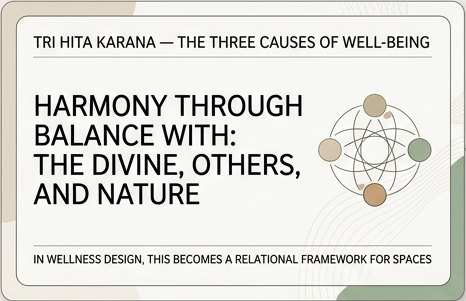
The Balinese philosophy of Tri Hita Karana offers a different perspective. Translated as "three causes of well-being," it teaches that harmony is a balance of three relationships: our relationship with the divine, with others, and with nature.
This may sound simple, but it can present an interesting perspective on how we think about our homes. Instead of asking whether a space looks calm, Tri Hita Karana asks whether it supports rest and reflection, nurtures meaningful connections, and fosters a sense of belonging within the natural world.
In many ways, this philosophy challenges the modern tendency to treat wellness as a collection of products or aesthetics. A curated room may support wellbeing, but only if it also strengthens these deeper relationships.
Thus, wellness, from the Tri Hita Karana perspective, is not a style or aesthetic but the result of how we balance the three relationships in our interiors. Rather than viewing harmony and wellbeing as something to be attained, it proposes it as something to be cultivated.
As concerns about stress, burnout, loneliness, and disconnection from nature grow, this centuries-old framework is relevant to modern lifestyles. It invites us to see our homes not merely as shelters or expressions of personal style, but as environments that actively shape our wellbeing.
The question, then, is not whether your home looks like a wellness space but whether it helps you live in harmony with yourself, your community, and the natural world around you.
Key Takeaways
What is Tri Hita Karana?
The phrase Tri Hita Karana translates to "three causes of well-being." Rooted in Balinese Hinduism, it teaches that a fulfilling life depends on maintaining balance across three fundamental relationships: with the divine, with other people, and with nature.
These three relationships are known as:
- Parahyangan: harmony with the divine and the sacred.
- Pawongan: harmony with family, community, and society.
- Palemahan: harmony with the natural environment.
The Tri Hita Karana philosophy posits that these relationships are interconnected. Therefore, one cannot achieve well-being by strengthening one while neglecting the others. For example, you might enjoy material comfort but are disconnected from family and friends. You may have a thriving social life but are lonely and detached from your environment. Harmony emerges when you nurture all three relationships together.
This philosophy extends beyond personal beliefs and into everyday life in Bali. It influences community structures, land stewardship, architecture, and the organisation of public spaces. Rather than treating people, buildings, and landscapes as separate systems, Tri Hita Karana views them as part of a larger, interconnected whole.
Tri Hita Karana in wellness design
If you search “wellness” or “wellness design,” the results will look almost identical: a neutral palette, abundant natural light, candles, plants, and the suggestion of yoga. This is the visual shorthand the internet sells as wellness.
While these elements can contribute to well-being, it doesn’t guarantee we’ll feel well within those spaces. Tri Hita Karana gives us an experiential perspective where we consider our relationship to the environment so as to achieve well-being.
So, wellness is not something we add to a room through products or aesthetics but something we cultivate through the interactions a space makes possible. A home becomes a wellness environment when it supports your relationship with yourself, strengthens your connections with others, and fosters an ongoing relationship with the natural world.
A bedroom, for example, is not simply a collection of furniture and finishes but an environment that supports restoration. A dining area is more than a table and chairs. It creates opportunities for gathering, conversation, and shared rituals. A window is not merely an architectural feature but a daily point of connection to daylight, fresh air, natural smells and soundscapes, weather patterns, and seasonal change.
From this perspective, we can consider wellness design as more about creating balance than an aesthetic. Therefore, every design decision, from spatial planning to material selection, strengthens one or more of these relationships.
The result is a home that actively supports the conditions that allow wellbeing to flourish.
Design applications of Tri Hita Karana
Once you understand wellbeing as a balance between self, others, and nature, we can evaluate every design decision through these three lenses. The relationship with self begins with how a space supports your physical, emotional, and mental wellbeing.
This includes natural light, thoughtful storage solutions, and clear spatial boundaries that contribute to a sense of ease. It's about creating environments that help you function at your best. For example, a bedroom that encourages sleep, a quiet meditation corner, or a WFH desk separated from areas of relaxation.
However, our homes are typically not personal sanctuaries, but places where we nurture relationships with friends and family. Furniture arrangement, how people move through a room, and whether spaces invite gathering all influence social connection. A dining table for shared meals, a welcoming front porch, or a living room organised around conversation rather than a television can encourage interaction and strengthen bonds.
The third relationship asks us to consider how our homes connect us to the natural world.
This goes beyond adding decorative plants. It involves bringing natural systems and sensory experiences into everyday life. Daylight, fresh air, garden views, natural materials, seasonal changes, and outdoor living areas all strengthen this connection.
When nature is integrated thoughtfully, it becomes part of the home's daily rhythm. The morning sun marking the start of the day, the breeze moving through an open window, or the texture of timber underfoot all remind us that we are part of a larger ecosystem.
In this sense, design becomes a tool for hospitality. It creates opportunities for the small rituals and everyday moments that turn houses into homes.
A simple reflection
Viewed through the lens of Tri Hita Karana, wellness design supports all three relationships simultaneously.
A home office, for example, might offer daylight and views of the outdoors (nature), provide a focused environment for meaningful work (self), and include two armchairs for collaboration or family interaction when needed (others). Before making your next design decision, ask yourself three questions:
- Does this support my wellbeing?
- Does this help me connect with others?
- Does this strengthen my connection to nature?
If the answer is yes to all three, you're already designing in the spirit of Tri Hita Karana.
Why Tri Hita Karana matters today
We live in an era where many of us experience burnout, loneliness, and are cut off from the natural environment. Ironically, these challenges correspond to the three relationships Tri Hita Karana seeks to balance.
Many of us spend our days moving between digital spaces, artificial lighting, and demanding schedules. We are more connected technologically than ever, yet social isolation continues to grow. At the same time, our daily contact with nature is often limited to brief moments between buildings, vehicles, and screens.
Within this context, Tri Hita Karana offers more than a philosophy. It reminds us that wellbeing is relational. It is shaped not only by what we consume or achieve, but by how we connect: with ourselves, with the people around us, and with the environments we inhabit.
For designers, this perspective shifts the goal from creating beautiful spaces to creating supportive ones. Well-being is not something we find through a single product, trend, or design feature. Rather, it emerges from the quality of our relationships and the environments that sustain them.
In an era focused on aesthetics and optimisation, this may be the most valuable design lesson of all.